
Recent project · Maryland · Restoration Services of Maryland, the 24/7 division of Mid-Atlantic Remodeling Co.
Flooring after water damage
A failed water heater flooded this Maryland family room at 2 a.m. Our restoration crew had it drying by 3:30; our flooring crew put it back with waterproof luxury vinyl plank.
Project at a glance
| Location | Baltimore County, Maryland |
|---|---|
| Scope | Emergency water extraction, drying, demolition of wet materials, antimicrobial treatment, build-back, new flooring |
| Response | On site 70 minutes after the call |
| Drying | Four days; 6 air movers, 2 dehumidifiers, daily moisture readings |
| Build-back | Lower drywall, baseboard, paint, waterproof luxury vinyl plank |
| Billing | Direct to the homeowner's insurance carrier; homeowner paid the deductible |
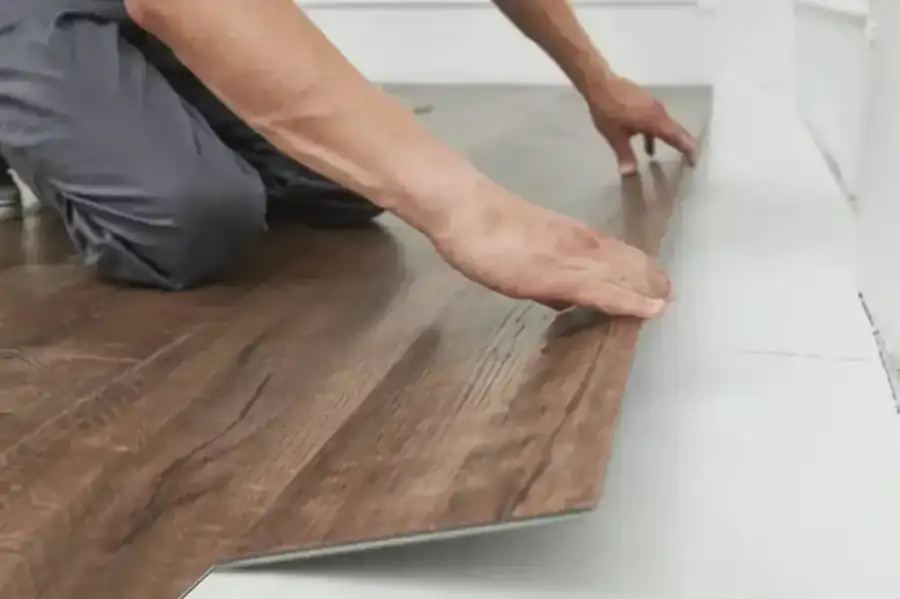
Services on this job: Water damage · Full build-back · Insurance billing · Luxury vinyl & laminate
The situation
The call came in at 2:10 in the morning. The water heater in the utility closet off the family room had let go, and by the time the homeowner woke up to the sound, there was an inch of water across the family room, into the hall and under the laminate floor. She shut the water off at the main, called the number on our website, and a person answered. The crew was dispatched while she was still on the phone and arrived at 3:20.
Laminate flooring is the worst case in a flood. It looks like wood but the core is compressed fiber that swells the moment it gets wet, and water that gets under it sits against the subfloor with nowhere to go. The first hour matters more than anything else that happens afterward; every hour standing water sits, it soaks deeper into drywall, baseboard and subfloor, and mold can start within 48 hours. We extracted first and documented as we went.
What we did
- 24/7 call answered live; crew dispatched during the call, on site in 70 minutes
- Truck-mounted extraction of standing water from the family room, hall and closet
- Moisture mapping of every wall, floor and the subfloor; photos and readings logged for the claim
- Wet laminate and underlayment removed; wet baseboard removed; drywall cut 24 inches up along the affected walls
- Antimicrobial treatment on the subfloor and framing
- Six air movers and two commercial dehumidifiers set; readings taken daily until the subfloor hit target
- Estimate written in the carrier's format and submitted; adjuster met on site
- Build-back: new lower drywall, taped and finished, new baseboard, two coats of paint
- Waterproof luxury vinyl plank installed by the Carpets Etc. crew; furniture reset
How the job went
The first two hours were extraction. A truck-mounted unit pulls far more water than any portable machine, and getting the standing water out before it wicks up the drywall is the single biggest factor in how much of the room can be saved. While the extraction ran, our lead took moisture readings on every wall and across the floor with a pin meter and logged them with photos. Those readings are the claim file; they prove what was wet and how far the water traveled.
By sunrise the laminate was coming up. It had already swollen at every seam and the underlayment was saturated; none of it was salvageable. The baseboard came off, and the drywall was cut at 24 inches along the three walls that had wicked water, which is standard practice because drywall pulls water up well above the visible line. The subfloor was sound plywood, so it was treated with an antimicrobial and dried rather than replaced. Six air movers and two dehumidifiers ran for four days; our technician came back every morning to log readings until the subfloor and framing were at target moisture.
The build-back started the day the drying equipment came out. New lower drywall went in, taped and finished to match, baseboard replaced, and the room painted. Then the Carpets Etc. crew installed a waterproof luxury vinyl plank in a wood look close to what had been there. If this room ever floods again, that floor will survive it; the laminate never would have.
Materials and methods
Extraction was done with a truck-mounted unit; drying with centrifugal air movers and low-grain refrigerant dehumidifiers sized to the room’s cubic footage. The antimicrobial is an EPA-registered product applied to all exposed wood. Moisture readings were taken with a pin meter on wood and a non-invasive meter on drywall, and the drying targets come from the industry standard the carriers recognize.
The replacement floor is a rigid-core luxury vinyl plank with an attached pad, 100 percent waterproof, in a medium oak look. Unlike laminate, the core is a stone-polymer composite that does not absorb water; it can sit in a flood and be dried out and reused. It clicks together as a floating floor over the plywood subfloor, so there is no glue and no fasteners to trap moisture. New drywall is standard 1/2-inch with a mold-resistant facing; baseboard is primed MDF to match the original profile; paint is a scrubbable eggshell.
Why it matters for Baltimore County homeowners
Baltimore County basements and ground-floor rooms flood for the same handful of reasons: failed water heaters, sump pumps that quit in a storm, washing machine hoses, and the heavy summer downpours that overwhelm older drainage. Most of those are covered by a standard homeowner’s policy as sudden, accidental water damage; groundwater seepage usually is not. We tell you which you have in the first hour so there are no surprises on the claim.
The county’s humidity also means drying has to be done with equipment, not fans and open windows. A room that feels dry can still have a subfloor at 25 percent moisture, and that is where mold starts. Daily readings until target is the only way to know it is actually dry.
Cost, insurance and what the owners paid
The homeowner paid her deductible. Everything else, extraction, drying, demolition, antimicrobial, build-back and the new floor, was billed directly to her insurance carrier from an estimate written in the carrier’s own format, backed by the moisture logs and photos. Our estimator met the adjuster on site, walked the readings, and the claim was approved without a supplement.
She upgraded the flooring from laminate to waterproof luxury vinyl plank. Insurance pays for like-for-like, so she paid the small difference for the upgrade, and the next leak will not cost her a floor. One company handled the 2 a.m. call, the drying, the adjuster and the last piece of baseboard.
What to expect if you hire us for a job like this
Every Restoration Services of Maryland job starts with a phone call that a person answers, 24 hours a day. The crew is dispatched while you are on the line and on site within the hour across Baltimore and most of central Maryland. Extraction starts immediately; moisture readings and photos are logged from the first hour because they are the claim file. Wet materials that cannot be saved come out, everything that can be saved is dried with commercial equipment and checked daily until it hits target, and antimicrobial treatment goes on anything that got wet. Our estimator writes the mitigation and build-back estimates in the format your carrier uses, meets the adjuster on site and submits supplements if hidden damage turns up. Then our own carpenters, painters and flooring crew put the room back. You pay your deductible; we bill the carrier; you deal with one company from the first call to the last coat of paint.
Questions about this kind of project
How fast can you get here?
Within an hour across Baltimore and most of central Maryland, day or night. A person answers the phone and the crew is dispatched while you are still on the line.
Do I pay you or does insurance?
We bill your carrier directly. You pay your deductible; we handle the estimate, the documentation and the adjuster.
Can laminate be saved after a flood?
Almost never; the core swells within hours. Luxury vinyl plank, tile and often hardwood can be saved if we get there fast.
What should I do before you arrive?
Shut off the water source if you can, kill power to the affected area at the breaker, and move small valuables. Do not use a household vacuum on standing water.
Related projects
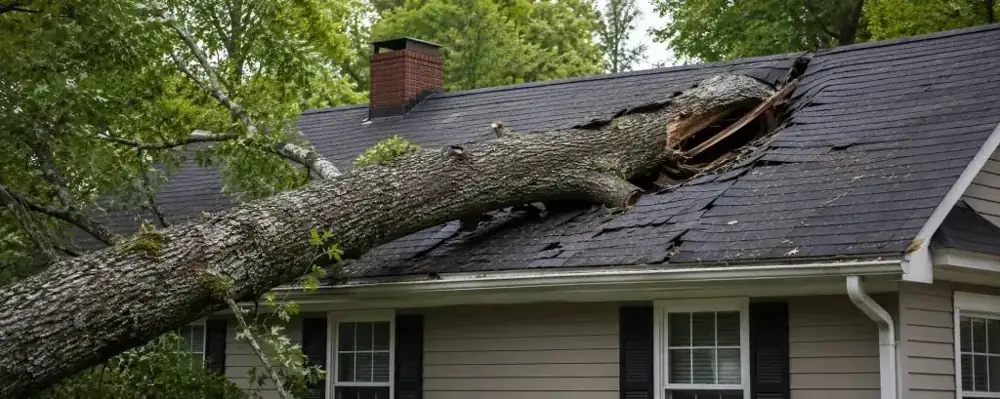
Storm damage: tree through roof
Baltimore, MD. A summer storm dropped an oak through this Baltimore roof.
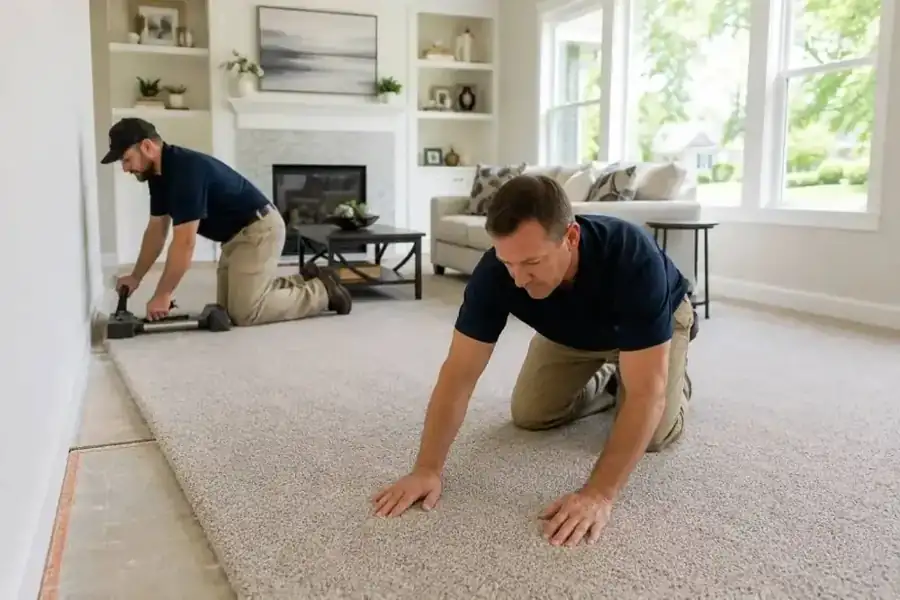
Living room carpet
Baltimore, MD. Plush stain-resistant carpet, power-stretched over an 8-pound pad, in a bright Baltimore living room.
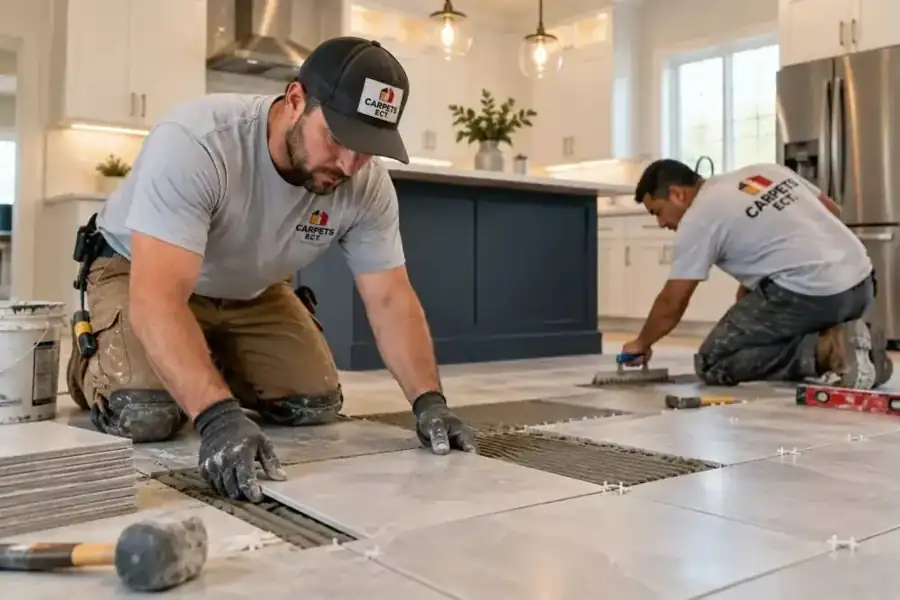
Large-format ceramic tile
Maryland kitchen. 24x24 porcelain tile in a Maryland kitchen, set dead level over an uncoupling membrane with a leveling clip system by the Carpets Etc.
Serving every county in Maryland
From Baltimore and Harford County to the Eastern Shore and Western Maryland, our crews work across Allegany, Anne Arundel, Baltimore City, Baltimore County, Calvert, Caroline, Carroll, Cecil, Charles, Dorchester, Frederick, Garrett, Harford, Howard, Kent, Montgomery, Prince George’s, Queen Anne’s, St. Mary’s, Somerset, Talbot, Washington, Wicomico and Worcester counties. Based at 1012 Saddle View Way, Forest Hill, MD 21050.
- Baltimore City & Baltimore County
- Harford & Cecil
- Howard & Anne Arundel
- Carroll & Frederick
- Montgomery & Prince George's
- Eastern Shore & Western Maryland
Ready when you are
Tell us about the job and someone from Mid-Atlantic Remodeling will call you within one business day. Storm or water emergency? Call (410) 780-9100 now; we answer 24/7.