
Recent project · Baltimore, MD · RooferMD, the roofing division of Mid-Atlantic Remodeling Co.
Storm damage: tree through roof
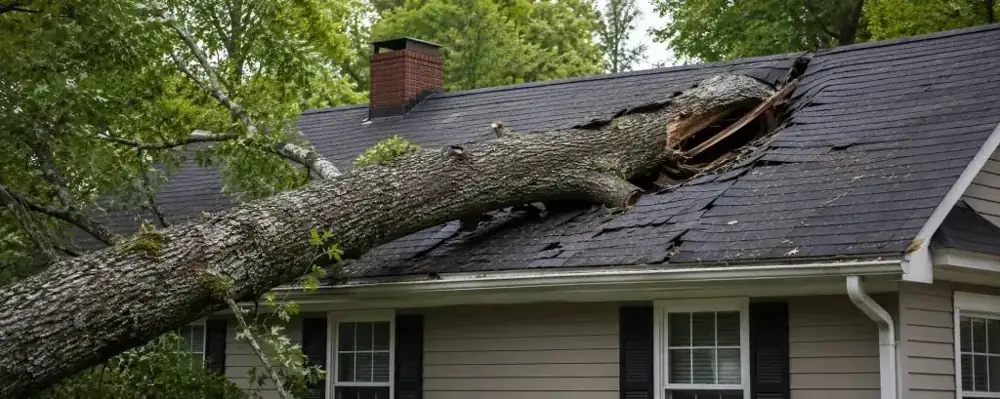
A summer storm dropped an oak through this Baltimore roof. Emergency tarp the same night, the whole insurance claim handled for the family, a new roof with a 50-year warranty and the interior rebuilt.
Project at a glance
| Location | Baltimore, Maryland |
|---|---|
| Scope | Emergency limb removal and tarp, interior water mitigation, insurance claim, full roof replacement, framing and decking repair, interior build-back |
| Response | Tarped within three hours of the call, during the storm |
| Roof | Architectural fiberglass shingles, Charcoal, synthetic underlayment, ice-and-water shield; three rafters and 14 sheets of decking replaced |
| Interior | Bedroom ceiling and one wall replaced, insulation replaced, painted |
| Billing | Direct to the homeowner's insurance carrier, including two supplements; homeowner paid the deductible |
Services on this job: Storm restoration · Water damage · Insurance billing · 50-year warranty
The situation
A line of thunderstorms came through Baltimore on a July evening with straight-line winds that took down trees across the north side of the city. One of them was a mature oak in this family’s side yard. It came down across the roof, through the shingles and decking, and broke three rafters over a back bedroom. Rain was coming into the bedroom and down into the kitchen below when they called our 24/7 line at 8:40 p.m.
The first job in a storm emergency is to stop the water. Our crew was on site by 11:30 with chainsaws and tarps, cut the limb that was still in the roof, cleared enough of the tree to get a tarp over the opening, and had the house watertight before midnight. The restoration crew followed the next morning to start drying the bedroom and kitchen. Only after the house was safe did anyone talk about the claim, and the family did not have to talk to their insurance company about anything technical at all. That was our job.
What we did
- 24/7 call answered; emergency crew on site in under three hours during the storm
- Limb cut out of the roof, tree cleared from the opening, heavy-duty tarp installed and secured
- Restoration crew on site next morning: extraction, moisture mapping, drying equipment in the bedroom and kitchen
- Full roof inspection and photo documentation; written estimate in the carrier's format for roof, structure and interior
- Claim filed with the family; adjuster meeting on the roof with our inspector
- Tree removal coordinated; three broken rafters sistered and replaced, 14 sheets of decking replaced
- Full roof replacement approved: architectural shingles, synthetic underlayment, ice-and-water shield, new ridge vent
- Two supplements submitted for hidden damage found during repairs; both approved
- Bedroom ceiling, wall, insulation and paint replaced; kitchen ceiling repaired; final walkthrough
How the job went
Night one was triage. You cannot assess a roof in the dark in a storm; you can make it stop leaking. The crew cut the limb that had punched through, chained the trunk so it could not shift, and ran a reinforced tarp from the ridge down past the eave, battened down so the wind could not lift it. The family slept in the house that night.
Morning two, the restoration crew extracted the water from the bedroom carpet and the kitchen below, pulled the wet insulation out of the ceiling, and set drying equipment. At the same time our roofing inspector walked the whole roof, not just the hole. Storm damage from a tree is obvious; the wind damage to the rest of the roof is not, and the same storm had creased and lifted shingles across the entire rear slope. All of it was photographed and measured, and the estimate we wrote covered the roof, the framing, the decking and the interior as one claim.
Our inspector met the adjuster on the roof four days later and walked him through the photos. The carrier approved a full replacement, not a patch, because the wind damage was documented across the whole slope. Once the tree service had the trunk off, our crew replaced the three broken rafters, decked the opening and the surrounding damaged sheets, and re-roofed the whole house. During the repair we found two more cracked rafters the tree had hidden; that went in as a supplement with photos and was approved. The restoration crew then rebuilt the bedroom ceiling and wall, replaced the insulation, repaired the kitchen ceiling and painted. The family paid their deductible.
Materials and methods
The emergency tarp is a reinforced 12-mil poly secured with battens screwed into the deck rather than sandbags, which is what keeps it on in the next storm. Structural repair used dimensional lumber sistered to the existing rafters with structural screws, and new 1/2-inch CDX decking on the opening and every sheet the tree or the water had damaged.
The new roof is an architectural fiberglass shingle in Charcoal with a 130 mph wind rating, over synthetic underlayment with ice-and-water shield at the eaves, valleys and around the chimney and every penetration, with a vented ridge. The interior used mold-resistant drywall on the ceiling and wall, new fiberglass insulation, and a scrubbable paint. Drying equipment was commercial air movers and a dehumidifier sized to the two rooms, with daily moisture readings logged until target.
Why it matters for Baltimore homeowners
Baltimore’s older neighborhoods have mature trees over almost every roof, and the summer storm season brings straight-line winds and the occasional microburst that bring them down. A tree through the roof is the dramatic version; the common version is the wind damage across the whole roof that nobody notices until the next leak. Both are covered by a standard homeowner’s policy as storm damage, and both should be inspected and documented by a roofer before you talk to the carrier, because the adjuster is going to look for a reason to patch rather than replace.
Our storm restoration process is built for this: free inspection, documentation in the carrier’s format, our inspector on the roof with the adjuster, and supplements when hidden damage turns up. The homeowner pays the deductible and gets a new roof with a 50-year transferable warranty.
Cost, insurance and what the owners paid
The family paid their deductible. The emergency tarp, water mitigation, structural repair, full roof replacement and interior build-back were all billed to their insurance carrier. The two supplements for the hidden rafter damage were documented with photos during the repair and approved without dispute.
Storm claims go wrong when the homeowner accepts the adjuster’s first estimate for a patch, or when the roofer does not document the wind damage beyond the obvious hole. Ours cover the whole roof, the structure and the interior as one claim, written in the format the carrier uses, so the family dealt with one company and one phone number from the night of the storm to the last coat of paint.
What to expect if you hire us for a job like this
Every RooferMD roof follows the same steps, whether it is a storm claim or a planned replacement. It starts with a free inspection from the attic and the roof, with photos you keep, and an itemized quote that prices decking per sheet so the worst case is on paper before we start. We schedule around the forecast, stage the dumpster and materials the day before, and our own crew, not a subcontractor, does the work. The deck is inspected sheet by sheet during tear-off, every eave and valley gets ice-and-water shield, every shingle gets six nails, and the attic ventilation is checked and fixed because it is what decides how long the roof lasts. We sweep the yard with a magnet, walk the finished roof with you, and hand you a 50-year transferable limited warranty in writing. If the roof was storm damaged, our inspector documents the whole roof, meets the adjuster, and bills the carrier; you pay the deductible.
Questions about this kind of project
What do I do when a tree hits my roof?
Get everyone out from under the damaged area, call us at (410) 780-9100, and do not go on the roof. We tarp the same day, then handle the inspection and the claim.
Will insurance replace the whole roof or just the hole?
That depends on documentation. If the storm damaged shingles across the roof, and it usually did, we photograph and measure all of it so the claim covers a full replacement, not a patch.
Who pays for the tree removal?
Most policies cover removal of a tree that damaged a covered structure. We coordinate the tree service and include it in the claim.
Do you handle the inside of the house too?
Yes. Our restoration division dries, treats and rebuilds the interior under the same claim as the roof.
Related projects

Flooring after water damage
Maryland. A failed water heater flooded this Maryland family room at 2 a.m.
Architectural shingle roof replacement
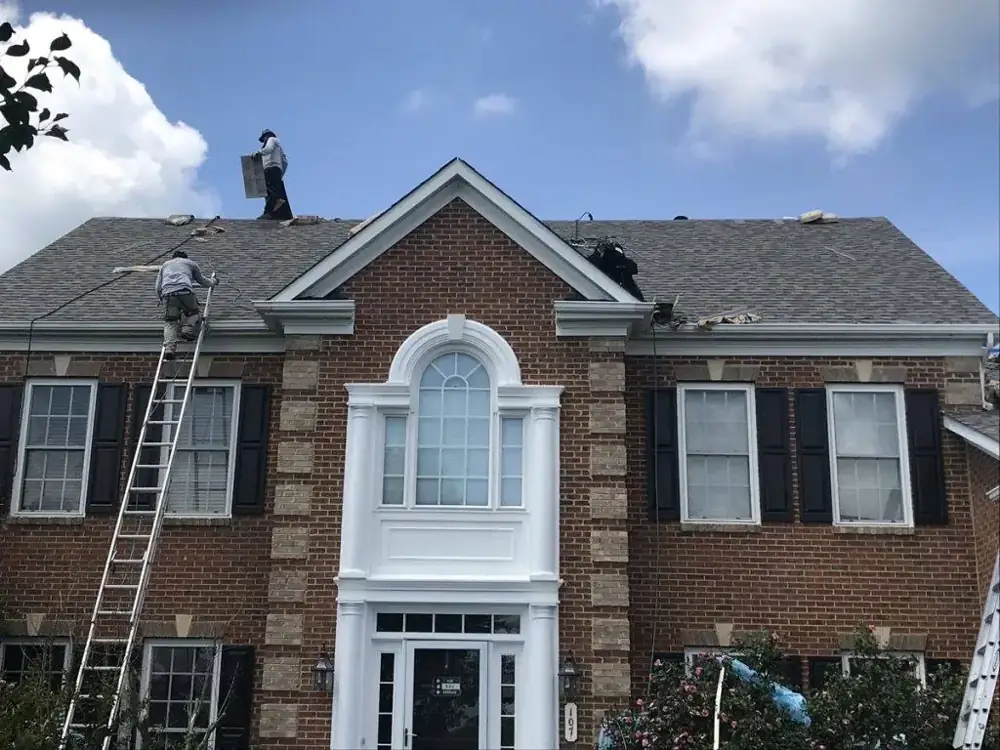
Baltimore County, MD. Full tear-off and partial re-deck on a two-story brick colonial in Baltimore County, finished in two days by our own crew and backed by a 50-year transferable warranty..
Re-decking and synthetic underlayment
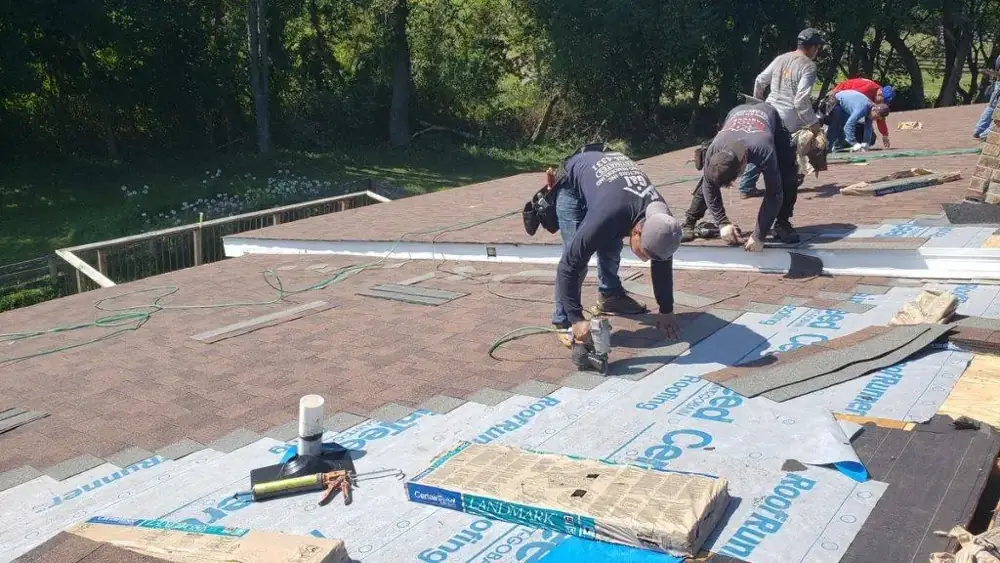
Maryland. Rotted and delaminated decking replaced across an entire roof before the new shingles went on.
Serving every county in Maryland
From Baltimore and Harford County to the Eastern Shore and Western Maryland, our crews work across Allegany, Anne Arundel, Baltimore City, Baltimore County, Calvert, Caroline, Carroll, Cecil, Charles, Dorchester, Frederick, Garrett, Harford, Howard, Kent, Montgomery, Prince George’s, Queen Anne’s, St. Mary’s, Somerset, Talbot, Washington, Wicomico and Worcester counties. Based at 1012 Saddle View Way, Forest Hill, MD 21050.
- Baltimore City & Baltimore County
- Harford & Cecil
- Howard & Anne Arundel
- Carroll & Frederick
- Montgomery & Prince George's
- Eastern Shore & Western Maryland
Ready when you are
Tell us about the job and someone from Mid-Atlantic Remodeling will call you within one business day. Storm or water emergency? Call (410) 780-9100 now; we answer 24/7.